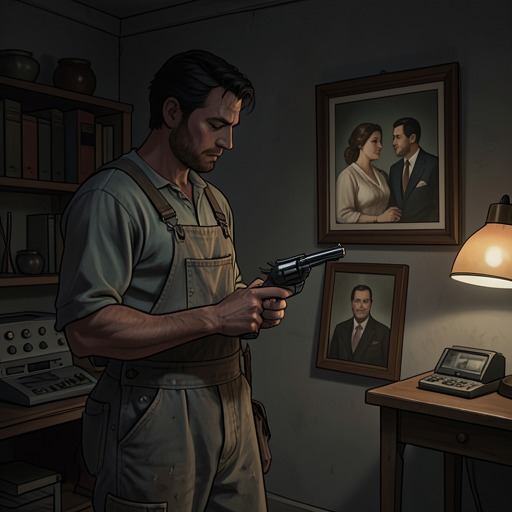
Arvin Eugene Russell
The Devil All the TimeArvin Eugene Russell’s childhood binds religious devotion to grief and violence: his father makes him pray through his mother’s final illness, and, after both parents are gone, Arvin carries forward his father’s fighting advice while using violence chiefly to protect Lenora. The surviving account follows him from a lonely boy in Knockemstiff to an adolescent living with Emma in Coal Creek, where loyalty and anger become closely entangled.
Identity and Early Setting
In 1957, Arvin is nine and lives with his parents, Willard and Charlotte, in a rented farmhouse above Mitchell Flats in Knockemstiff, Ohio. The family has lived there for five years, but the neighbors still regard them as outsiders. Arvin is the only child on his school bus who is not related to another passenger, and he has recently returned from school with a black eye. His isolation and his father’s approach to fighting are already part of his childhood before the later losses that redirect his life.
Willard takes Arvin to a clearing in the woods, where a weathered cross stands near a fallen oak. Unless he has been drinking, Willard goes there morning and evening to pray. Arvin is made to kneel beside him, though he would rather be in bed; he cannot decide whether his father’s drinking or his praying is worse. Religion thus enters Arvin’s life not simply as belief but as a repeated obligation imposed by a troubled parent. The clearing will become inseparable from the family’s crisis when Willard later sends him there to pray for Charlotte.
Charlotte’s Illness and Death
Charlotte hides worsening illness for months, partly because she fears the cost of hospital care and the loss of the money the family has saved for a house. When Arvin finds her unconscious in the kitchen, there is no telephone in the house. He props her head on a pillow, tries to clean up, and waits beside her, praying that her breathing will continue. A pan of biscuits is burning in the oven: an ordinary household task continues while the child confronts a danger he cannot manage. By the time Willard returns and a doctor sees Charlotte, it is too late to save her.
During Charlotte’s final decline, Willard wakes Arvin at night and orders him to go to the clearing and keep praying until he is fetched. Arvin runs there despite thinking about having wished his mother dead. The vigil lasts until his throat is raw; Willard returns once to urge him to continue, but Arvin feels no response to his prayers. Near dawn, Willard tells him gently that Charlotte has died. The loss therefore carries a specific contradiction for Arvin: he has been made responsible for praying for her recovery, yet the faith he is ordered to exercise does not prevent her death. He is ten when she dies in the summer of 1958.
Life with Emma and Lenora
After Willard’s suicide, Arvin is sent to live with his grandmother, Emma, in Coal Creek. The welfare workers have told her about the terrible summer he endured while Charlotte was dying, and Emma does not require him to pray, sing, or kneel at the altar. She takes him and Lenora to church each Sunday but leaves his personal faith to develop at its own pace. Emma’s restraint offers a marked contrast to Willard’s insistence that prayer must be made forceful enough to bring a response.
Arvin loves Lenora like a sister, although their closeness is not free of awkwardness. She is only a few months younger, and he can feel embarrassed when she follows him into school wearing the bonnet she insists on wearing. He also dislikes seeing her imitate her mother’s appearance after Emma gives her a photograph of Helen. Yet the embarrassment does not cancel his attachment: he fights the children who mock Lenora’s pious manner and appearance. His care for her becomes the clearest motive given for his repeated school fights.
Violence, Loyalty, and Inheritance
By fourteen, Arvin has been expelled from school several times for fighting. Emma can see Willard in him, especially in this behavior. Arvin is generally known around Coal Creek for getting along easily, but when he does fight, he follows his father’s advice to choose the moment. He catches opponents alone and unaware in places such as a restroom, stairwell, or beneath the gym bleachers. This method suggests not uncontrolled fighting in every encounter but violence selected and timed for advantage.
That capacity has an inherited and protective side. Many of the scraps that get Arvin in trouble begin when he defends Lenora from bullies. When Emma asks about his fighting, he thinks back to a day in Knockemstiff when Willard defended Charlotte’s honor in the Bull Pen parking lot. Arvin remembers it as the best day he spent with his father, but he has never told anyone about it; he also keeps silent about the bad days that followed. The memory helps explain why his father’s example remains powerful even after Willard’s death: Arvin preserves a moment of protective loyalty alongside the harsher legacy of violence.
Narrative Significance
Arvin’s early life places him between two forms of inheritance. From Willard he receives religious intensity and a practical lesson in how to fight; from Emma he receives room not to adopt another person’s faith by force. His attachment to Lenora gives his violence a protective purpose, but the consequences are still repeated expulsions from school. The contrast between his generally easygoing manner and his calculated fights makes him more than a simple continuation of his father: he has learned the method, but the account ties many of his uses of it to defending someone he loves. The available episodes establish this formation through concrete reversals—prayer that cannot save Charlotte, a father remembered for both tenderness and harm, and a grandson given greater freedom than his father allowed—without resolving the larger course of Arvin’s life.